Looks Like I'ma gonna be a Caddy Guy - Now What? Stroker L92 LS3 Build

Nice build data. I finished up a very similar build about a year ago. I even used JnJ Balancing in Jupiter and can't say enough good about Johnny and his father. He assembled a solid motor for me and knew of the inherent obstacles present in a stock ls3 being bored out for a airboat.

I did a few things differently than you of course but I'm very happy with my results. I'm pretty sure you will be as well seeing that you have a whole lot more technical expertise than I do.

I look forward seeing your finished project.
 
While it goes without saying . . .
I'm sure I'm not the only one that appreciates your documenting your exploits along the way and pointing out which paths are better left, not taken. Don't know when I might use some or all of this info, but in any case, Thanks in advance!

Nice build data. I finished up a very similar build about a year ago. I even used JnJ Balancing in Jupiter and can't say enough good about Johnny and his father. He assembled a solid motor for me and knew of the inherent obstacles present in a stock ls3 being bored out for a airboat.

I did a few things differently than you of course but I'm very happy with my results. I'm pretty sure you will be as well seeing that you have a whole lot more technical expertise than I do.

I look forward seeing your finished project.

I appreciate the attaboys and especially appreciate the "No Trophys Offered":whistle:

As long as I'm learning new crap and spending good money to do so, no reason everyone else can't benefit.

Deano,
My QJet days are coming to an end. Sorry!

One Man,
I have run a few engines through J&J, another waiting in the wings. I'm interested in the differences you mention, this is where the meat is.
 
Two things off the top of my head... I'm running higher pressure injectors, but I built for a possible future with forced air induction. My injectors are way down on their duty cycle with the hope that they will last. I am running 61lb of fuel pressure at my regulator. In other words, over built, underutilized. As you know, LS motors like fuel pressure. Not sure if that's a good or bad idea though, but it seems to work well so far.

I also fought with the idea of blanking off the heater lines from/ to the water pump but ended up running hoses to my expansion tank. Boat runs cool and I have never had any air pockets or coolant troubles.

I also converted my boat from a carbed 383 that gave up its ghost to holley terminator x efi system. I'm new to the efi game but from what I've seen first hand after about 14 months of riding Kissimmee, Okeechobee, and the glades loaded to the gills with either bodies, hunting gear, or both, I'm a believer. I don't recall your route, but I cut my fuel tank and installed in tank dual fuel pumps that have been flawless. Actually, aside from slightly playing with pitch, and one oil pressure sensor going out, it has been flawless. Quick note on the oil pressure sensor: I recently installed a mech guage next to it on the oil filter manifold so that there is no more wondering if the sending unit is bad or if I really have erratic oil pressure. Just a peace of mind addition for verification.

The truth is, I'm not sure if any of my approach is correct. I've read a ton and there's no general consensus on any of it and I'm not a engine builder. I am, however familiar enough with motors and other systems having spent 36 years working in the maritime industry. Given your technical knowledge and detail oriented posts, I'm listening to what you're saying and very interested in your approach.

I'm running a 2.55 box with 3 jr blades about 24-25 degrees. Turning about 5300 or so rpm on a 13.6 D Back hull with stainless rigging. She will haul 5 of us with coolers and a grill up the hill without too much effort for lunch so I'm happy. Cruise is about 25 to 30 @ 2700 to 3300 rpm. On its maiden voyage my son and I hit 51 at 5k and it was climbing pretty good. I've thought about pulling some pitch out and spinning it up but don't need it. I just feel like I built it to be all in about 6k but again, I prefer being over built and underutilized rather than running on the ragged edge and maxing out everything . ;)

Needless to say, I think I left myself some room to grow. Don't think I'll do it though. There's a lot of truth in these pages about costs being outrageous even if you're building it yourself.

I'm curious about your thoughts concerning the heater lines on these motors. Also, any comparative knowledge you or anyone else may have between a truck intake manifold and a fabricated aluminum intake from holley? I have the holley fab alum on my boat. I'm running a 102mm throttle body.
 
Last edited:
Two things off the top of my head... I'm running higher pressure injectors, but I built for a possible future with forced air induction. My injectors are way down on their duty cycle with the hope that they will last. I am running 61lb of fuel pressure at my regulator. In other words, over built, underutilized. As you know, LS motors like fuel pressure. Not sure if that's a good or bad idea though, but it seems to work well so far.
On the injector subject, the final injectors are 100 lb/hr when I need maybe 50, fuel pressure is set at 58 PSI. I still have to build the boat but have been thinking about dual in tank pumps. The tuner is arguing for a pickup pump on the main tank to a ~1 gallon tank with the HP pump to make sure the engine is getting fuel with a tank near empty. I am thinking about using the Holley Hydramat with in tank pumps as the solution.

https://www.holley.com/products/fuel_systems/hydramat/

Also, any comparative knowledge you or anyone else may have between a truck intake manifold and a fabricated aluminum intake from holley? I have the holley fab alum on my boat. I'm running a 102mm throttle body.

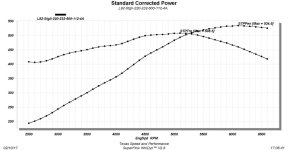
I am using the truck intake from the L92. This fits the 92 mm throttle body I am using. For comparison look at the green line on the torque curve I posted. The green torque curve is a Motor Trend 416 with a FAST intake and 102mm throttle body. My engine came in (hit 500 ft-lbs) 500 RPM earlier than the Motor Trend build and lost by 5 Hp at 6,300 RPM. Adding the K&N filter brought my engine in even sooner. Seems like the 92 mm throttle wins here.

Motor trend did a test of 20 different intake manifolds on a LS3.

https://www.motortrend.com/how-to/giant-ls3-intake-manifold-dyno-shootout/
 
My injectors are 80lb, fyi.

I have the hydra mat duals in my tank. Knock on wood it has been flawless.

I was concerned about my intake being too big at 102mm. I wouldn't mind trying a truck intake like yours. I rolled the dice when selecting size and type, and so far I'm happy, but as with a lot of things I always wonder what if I tried this.

Any thoughts on the heater block off or routing? Also, in case I missed it, how much compression are you running?
 
My injectors are 80lb, fyi.

I have the hydra mat duals in my tank. Knock on wood it has been flawless.

I was concerned about my intake being too big at 102mm. I wouldn't mind trying a truck intake like yours. I rolled the dice when selecting size and type, and so far I'm happy, but as with a lot of things I always wonder what if I tried this.

Any thoughts on the heater block off or routing? Also, in case I missed it, how much compression are you running?

Regarding expansion tank, I am nowhere near on a boat build, but my thinking is to run the inner port on my water pump (The Hot Side) to my expansion tank and leave the outer port plugged (vs. the dual hoses you mention).

11.3 compression, nothing crazy vs. stock 10.5, just planning 93 full time. The Texas Speed cam sheet and dyno run on the standard stroke 6.2 are below.

Regarding intake and throttle body, this subject has been discussed on Southern Airboat excessively. But even planning 5,500 run out, we are building pickup trucks not Ferraris. The factory configured the L92 I started with to power the Escalade and make power/torque to 5,500 RPM.

The stock throttle body is 87 mm and the intake manifold opening is ~94mm. The stroker adds 10% more displacement, so the optimum throttle body is about 10% more area (not accounting for cam). Geometry as it is, the optimum throttle body is 87*(1.10^0.5) = 91 mm.

Now, this is strictly based on displacement and assumes the cam adds similar. In reality we are all building for more torque through more airflow, so sizing beyond that is where the magic happens. For me, I would be happy to move the torque curve down from 5,500, plus Johnny gave me a 92 mm throttle body which bolted right up. So, the 92mm was a no brainer. Going larger in the market involves aftermarket intake manifolds, which are all tuned for making maximum Hp at 6,000 RPM Plus and use 102mm and larger throttle bodies which are (102/87)^2) = 137% or larger (in area) than stock to make beyond 600 Hp.

Unless you are turning the engine (regularly) to 6,000 RPM and beyond the 102 mm throttle body and Holley intake are too big. They hurt your performance/torque at normal operating range (2,500-4,500 RPM). Top end power at 5,000-5,500 is likely similar.

Cam Specs 2.jpg

Texas Speed L92 Stage 2 Curve.jpg
 
I was actually concerned I may be going too big with my intake and throttle body for NA, but it is in place and working good so I will leave it for now.

I almost plumbed my heater lines exactly like you're thinking. That's the one area I did not make and run AN hoses and fittings so plugging the "cool" side wouldn't be a problem. I pulled the factory nipples and tapped the holes so a plug would screw right in. That would be a simple thing to try and see if there's any improvement or difference.

I'll see if I can dig up the fuel pumps part number and specs for you when I get off my tugboat, but I do know they are from Rhodes(sp?) Racing, and they're overkill for my build.

Thanks for all the technical numbers and your feedback. Moving from the old school, carbed, SBC to the fuel injected LS platform, and doing it myself was a eye opening learning experience. Not difficult, but I've definitely seen the light. Fwiw, it's good to hear you steered away from the holley injectors. Thankfully all of my resources told me that was not the way to go before I pulled the trigger.
 
Get that Thang put together already!🤣🤣

I sure want to, but work was busy last year and the boat is #2 on my list of projects right now. #1 is a 363 stroker, solid roller, small block Ford that I have been building along with the aluminum Caddy engine. Both engines are running Holley Dominator EFI. The 363 is a ground up build starting with a Dart 302 based block. The OEM Ford 302 block can handle bore and stroke to 347, the Dart block can handle additional bore to 363.

363 & Cobra.JPG

Not exactly an airboat project, but a great place to get on with learning the EFI system, it's been quite a learning curve.

The dyno story is long (story coming), but when finally sorted this engine made 555 ft lbs at 4,200 and 485 hp at 5,000 RPM, so she makes power where an airboat engine should. The intake is a long runner Trickflow with a 75 mm throttle body.

Cobra 363 Dyno #1.jpg


Right now I'm sorting out wiring and replumbing the fuel system. This install will be running an in-tank 340 LPH (90 GPH) fuel pump and 1/2" supply/return fuel lines so there is plenty of room to grow.

Cobra Fuel Line.JPG
 
I sure want to, but work was busy last year and the boat is #2 on my list of projects right now. #1 is a 363 stroker, solid roller, small block Ford that I have been building along with the aluminum Caddy engine. Both engines are running Holley Dominator EFI. The 363 is a ground up build starting with a Dart 302 based block. The OEM Ford 302 block can handle bore and stroke to 347, the Dart block can handle additional bore to 363.

View attachment 99538

Not exactly an airboat project, but a great place to get on with learning the EFI system, it's been quite a learning curve.

The dyno story is long (story coming), but when finally sorted this engine made 555 ft lbs at 4,200 and 485 hp at 5,000 RPM, so she makes power where an airboat engine should. The intake is a long runner Trickflow with a 75 mm throttle body.

View attachment 99539


Right now I'm sorting out wiring and replumbing the fuel system. This install will be running an in-tank 340 LPH (90 GPH) fuel pump and 1/2" supply/return fuel lines so there is plenty of room to grow.

View attachment 99541
I know the feeling. I've been working overtime every week for 19 months. Don't often feel like doing much else. Hooe ya get time to come down for at least the cookout at Mack's. Can definitely find ya a seat if you don't have a ride
 
Here is the 363 dyno story. It is relevant to my airboat since it runs the same Holley Dominator EFI.

When we originally went to dyno the 363 fumbled. When that happened, we swapped out everything for the LS, including a different Dominator ECU. In hindsight, I sure wish we had swapped ECU's before giving up on the Ford 363.

We spent the last half of 2024 resolving when I had time. The initial conclusion was insufficient valve spring pressure, but there was also a question about #4 injector not working. We added spring pressure with shims and replaced the Holley fuel injectors with a set from Fuel Injector Connection. All the Holley injectors worked when tested, but they were flowing 12.5% of each other per previous posts. That's a ridiculous variation and probably where I might just throw away an old set.

Late last year we put it on another dyno where I could leave it for a while to trouble shoot. The result was worse than the original run, wouldn't idle for crap, couldn't tune and then all the sudden lost USB coms with Dominator.

We shut down the dyno and I took the Dominator ECU home to check out. I could not get it to communicate and after time on the phone with Holley tech support and attempts to push a firmware update the resolution was to send it in for testing.

The next day the shop called with worse news. When the ECU lost coms it failed with all the injectors open. The dyno fuel pump was on a separate switch from the Holley, so while we were scratching our heads over WTF with the ECU coms, the fuel pump was busy filling up the cylinders with fuel. This is a Coast Guard certified ECU, I just found out it has a failure mode that opens up all the injectors WTF? I will note that the Dominator is supposed to drive the fuel pump. We were running it outside the control of the Holley ECU.

Lawyer input... I have no idea if the ECU had fuel pump hot at that time. I can't speculate on scenarios where the system is used in accordance with the instructions.

Now I had an engine sitting on the Dyno with a crankcase full of fuel and oil, an ECU shipping to Holley and a potential argument with all the players. I asked the shop about the 16 V system in use on the dyno. The ECU is rated for it, but power issues certainly appear top of the list for potential reasons for ECU failure, until we realized it failed at first use. The last thing I wanted to do was plug in another $2K Dominator without understanding the failure.

Ultimately the engine shop volunteered the test mule HP ECU they were willing to plug in. Add the cost of another Valvoline 20W-50 racing oil change and we produced the dyno results shown previously in a rush.

I had to produce documentation showing initial failure within the 1-year warranty, but Holley replaced the Dominator ECU under warranty. The clock is now ticking on the 90 days they gave me to confirm all is well, hence the movement to priority #1. It still cost me a half year and extra dyno costs.

The latest lesson learned:
I sure wish we had tried the LS Caddy Dominator ECU before breaking down the 363 last year.
 
Check out Aeromotive Stealth in-tank system.

a note the stealth system is designed for a max depth tank of 11"
I will when I get there on the boat, thanks. For the Ford build I am using the stock tank from a 1987 Mustang. The tank looked real good but I went ahead and had it lined/sealed with POR 15 Fuel tank sealer. Holley had a whole drop in 340 LPH pump kit for the tank so that's the car solution. Just this weekend I installed the new pump and level sender, plugged it in to the harness, turned the key and the fuel pump ran through its prime cycle.
 
Back
Top